Ethical Hacking:
Introduction
In today’s digital world, cybersecurity has become a critical priority for individuals, organizations, and governments. Ethical hacking—also known as penetration testing—is the practice of identifying and fixing security vulnerabilities before malicious hackers exploit them. One of the most powerful tools in an ethical hacker’s arsenal is Linux.
Linux is widely used in cybersecurity due to its flexibility, open-source nature, and strong community support. This beginner guide will walk you through the essentials of using Linux for ethical hacking, including why it’s preferred, key distributions, basic commands, and how to get started.
Why Linux is Important for Ethical Hacking
Linux plays a central role in ethical hacking for several reasons:
1. Open Source and Customizable
- Linux is free and open-source.
- You can modify it according to your needs.
- Security professionals can tailor tools and scripts easily.
2. Powerful Command-Line Interface (CLI)
- Most hacking tools run via terminal.
- CLI allows automation and faster execution.
- Essential for scripting and penetration testing.
3. Built-in Security Tools
- Many Linux distributions come preloaded with hacking tools.
- No need for manual installation of every utility.
4. Stability and Performance
- Linux systems are lightweight and efficient.
- Ideal for running multiple security tools simultaneously.
Best Linux Distributions for Ethical Hacking
Not all Linux distributions are designed for hacking. Here are the most popular ones:
1. Kali Linux
- Most widely used ethical hacking OS.
- Developed by Offensive Security.
- Comes with 600+ penetration testing tools.
2. Parrot Security OS
- Lightweight alternative to Kali.
- Focuses on privacy and security.
- Includes tools for development and cryptography.
3. BlackArch Linux
- Advanced distribution for professionals.
- Contains thousands of hacking tools.
- Requires prior Linux knowledge.
4. Ubuntu (with tools)
- Beginner-friendly.
- Can install tools manually.
- Good for learning Linux basics first.
Installing Linux for Ethical Hacking
You can install Linux in several ways:
Option 1: Virtual Machine (Recommended for Beginners)
- Install VirtualBox or VMware.
- Run Linux inside your existing OS.
- Safe and easy to manage.
Option 2: Dual Boot
- Install Linux alongside Windows.
- Choose OS at startup.
- Better performance than VM.
Option 3: Live USB
- Boot Linux from a USB drive.
- No installation required.
- Portable and convenient.
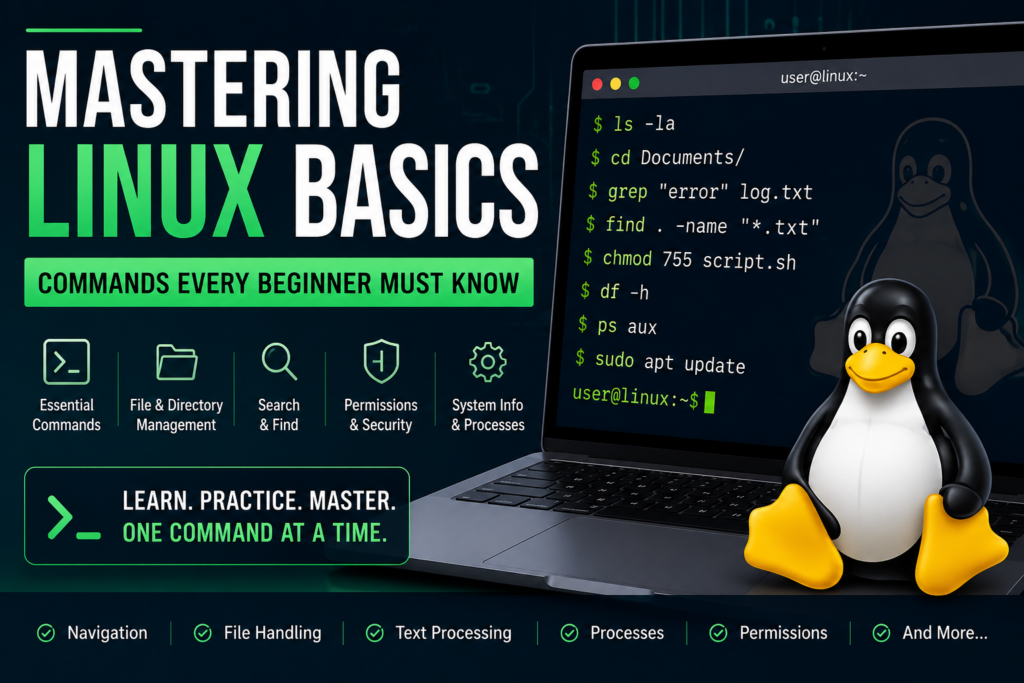
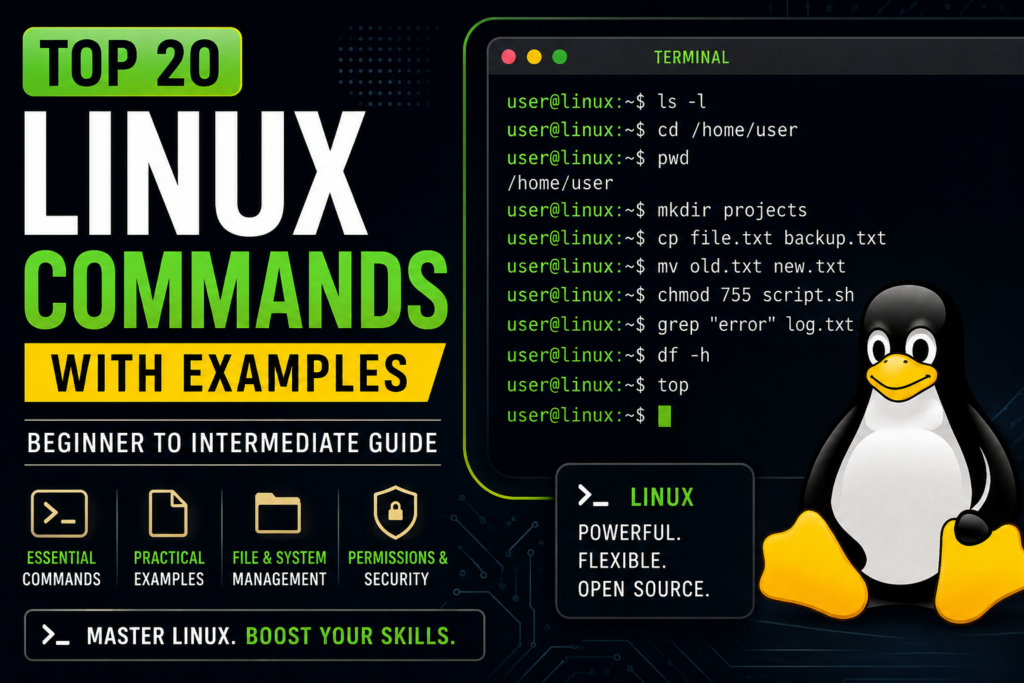
Basic Linux Commands for Beginners
Understanding Linux commands is essential. Here are some important ones:
File and Directory Commands
ls– List files and directoriescd– Change directorypwd– Show current directorymkdir– Create a directoryrm– Delete files
File Viewing Commands
cat– Display file contentless– View file page by pagehead– Show first linestail– Show last lines
System Commands
whoami– Show current useruname -a– System informationtop– Monitor processes
Networking Commands
ifconfig/ip a– Network detailsping– Check connectivitynetstat– Network connections
Essential Tools for Ethical Hacking
Linux distributions like Kali include many tools. Some key ones are:
1. Nmap (Network Scanner)
- Used for network discovery.
- Finds open ports and services.
Example:
nmap -sV 192.168.1.1
2. Wireshark (Packet Analyzer)
- Captures and analyzes network traffic.
- Helps detect vulnerabilities.
3. Metasploit Framework
- Powerful exploitation tool.
- Used for penetration testing.
Example:
msfconsole
4. Burp Suite
- Web application security testing.
- Intercepts HTTP requests.
5. Aircrack-ng
- Wi-Fi security auditing tool.
- Used for testing wireless networks.
Basic Ethical Hacking Workflow
Here is a simple step-by-step process:
1. Reconnaissance (Information Gathering)
- Collect data about the target.
- Tools: Nmap, Whois, DNS lookup.
2. Scanning
- Identify vulnerabilities.
- Tools: Nmap, Nikto.
3. Gaining Access
- Exploit vulnerabilities.
- Tools: Metasploit.
4. Maintaining Access
- Keep access for testing purposes.
- Use backdoors (ethical context only).
5. Covering Tracks
- Clear logs (for learning purposes).
- Understand attacker behavior.
Example: Simple Network Scan
Let’s see a beginner-level example:
nmap -sS 192.168.0.1
Output Explanation:
- Shows open ports.
- Identifies running services.
- Helps find entry points.
Safety and Legal Considerations
Ethical hacking must always follow legal guidelines.
Important Rules:
- Never hack without permission.
- Only test systems you own or are authorized to test.
- Follow cybersecurity laws in your country.
- Use tools responsibly.
Tips for Beginners
- Start with basic Linux commands.
- Practice in a virtual lab environment.
- Use platforms like:
-
- TryHackMe
- Hack The Box
- Learn scripting (Bash, Python).
- Stay consistent with practice.
Advantages of Using Linux for Ethical Hacking
- Free and open-source
- Highly customizable
- Strong community support
- Secure and stable
- Wide range of tools
Challenges You May Face
- Steep learning curve
- Command-line complexity
- Requires practice and patience
FAQs
1. Is Linux necessary for ethical hacking?
Yes, most ethical hacking tools are designed for Linux, making it essential for learning and practice.
2. Which Linux is best for beginners?
Kali Linux and Ubuntu are great starting points.
3. Can I learn ethical hacking without coding?
Yes, but learning basic scripting will give you an advantage.
4. Is Kali Linux legal?
Yes, but using it for unauthorized hacking is illegal.
5. How long does it take to learn?
It depends on practice, but basic skills can be learned in 2–3 months.
Conclusion
Linux is the backbone of ethical hacking and cybersecurity. Its flexibility, power, and vast ecosystem of tools make it the preferred choice for professionals worldwide. As a beginner, starting with a distribution like Kali Linux and learning essential commands will set a strong foundation.
Ethical hacking is not just about tools—it’s about mindset, discipline, and continuous learning. With dedication and the right approach, you can build a rewarding career in cybersecurity while contributing to a safer digital world.
Start small, stay consistent, and grow steadily—just like the strongest traditions of learning have always taught.
Also read: Mastering Linux Basics